
Native installers bundle their own Java runtime - nothing else to install. Prefer not to install? The full analyzer also runs in Chrome, Edge or another Chromium-based browser - try the web version.
Highlights
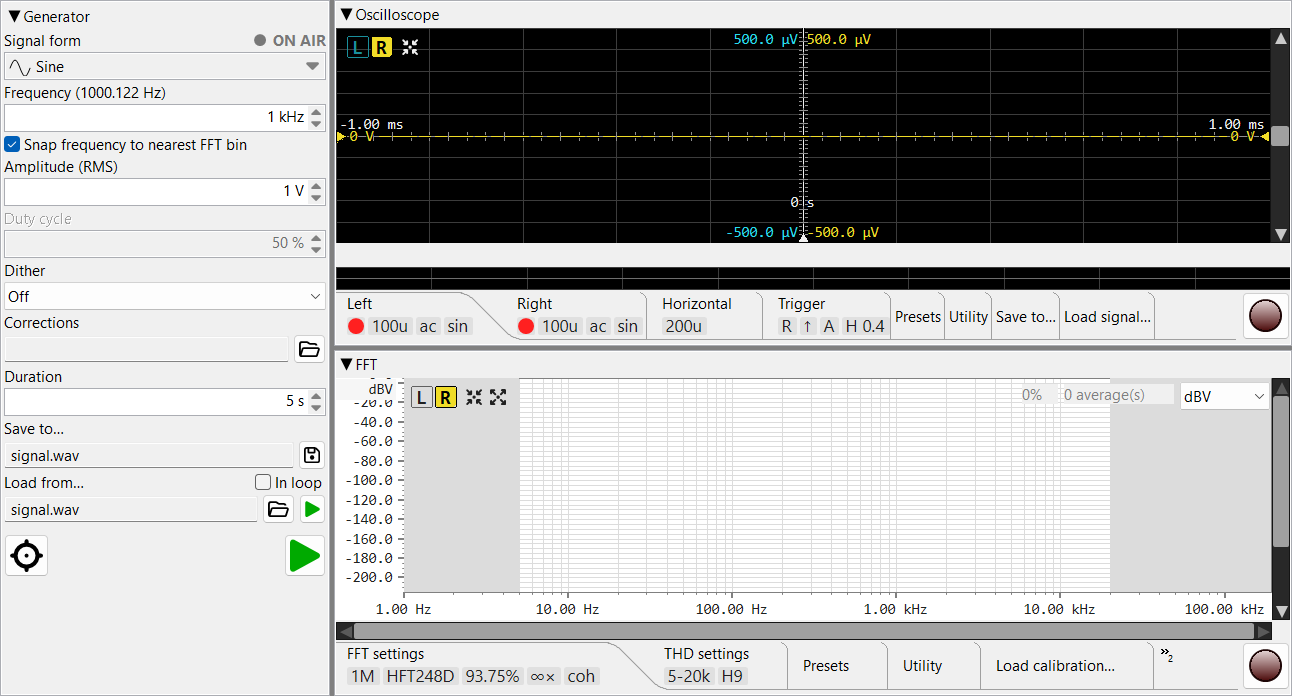
- FFT analyzer - THD, THD+N, IMD, SNR, ENOB, per-harmonic
readout, coherent averaging, selectable windows, and live
calibration (
.frc). - Ultra-low-distortion measurements - sub-ppm THD with a capable ADC/DAC (e.g. E1DA Cosmos), coherent averaging to pull the noise floor down.
- Oscilloscope - triggered time-domain view with Vpp/Vrms/period/frequency stats and an amplitude histogram.
- Frequency response - log-sweep / multitone with deconvolution and calibration.
- Signal generator - sine, dual-tone (IMD), sweep, DDS.
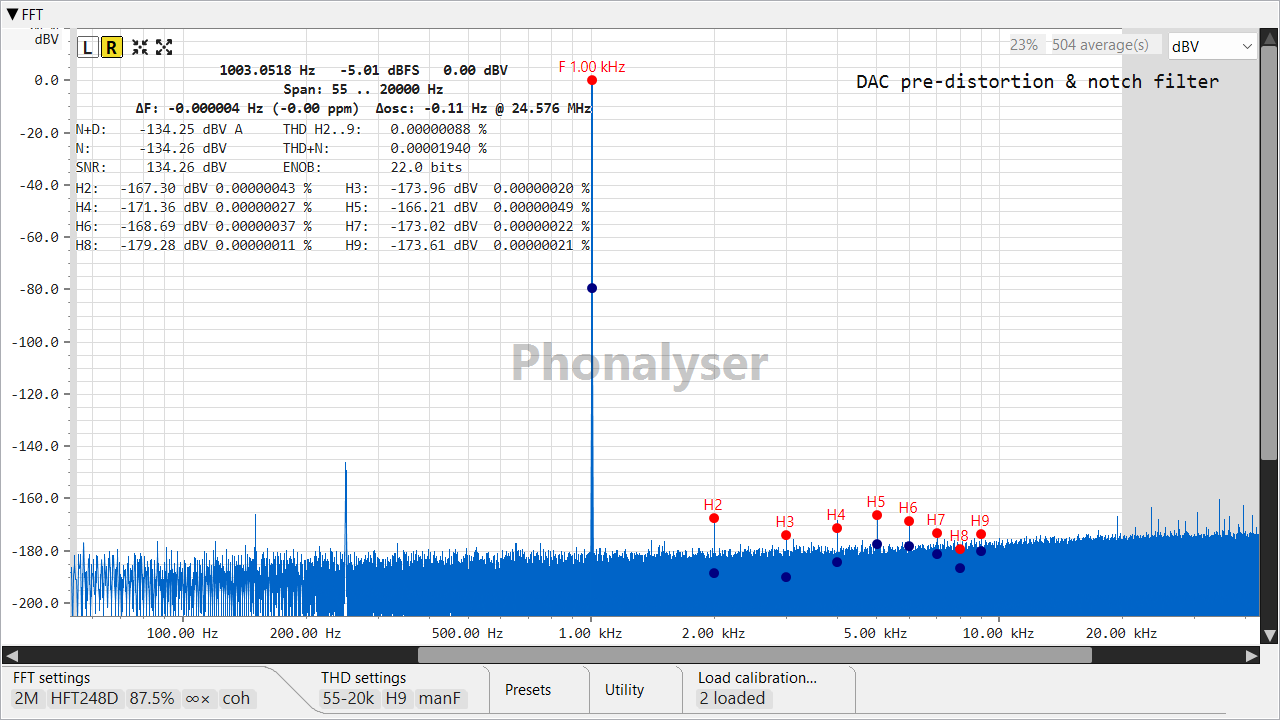
- DAC pre-distortion calibration - a closed-loop wizard that iteratively cancels the converter's own harmonics (and dual-tone IMD), pushing the playback chain's distortion far below what the DAC produces alone.
- Notch-filter tuning - a live module for trimming a passive twin-T notch: a continuously looping sweep tracks the null in real time so you can walk it onto the target frequency, then de-embed the notch's response from the FFT.
- Multi-backend audio - WASAPI & WDM-KS (Windows), CoreAudio (macOS), JavaSound (Linux), plus a direct QA40x (QA402/QA403) USB backend - on the desktop and, over WebUSB, in the browser; high sample rates and 16/24/32-bit.
- Network bench - a headless
phonalyser-serverturns the machine wired to the measurement hardware into a bench; the desktop app and the browser port measure through it as if the hardware were local - multicast discovery, per-client device locks naming the holder, cards and calibration living on the bench. - Per-card calibration - full-scale calibration follows the physical card across backends via name aliases, with a range table per attenuator / DIP position; the crosshair calibrations write straight into the card's active range.
Measurement bench
Wiring the bench so the cabling doesn't inject its own noise - a Faraday cage, CAT.8 twisted pair with XLR connectors, single-point grounding, and the resulting induced-noise budget - is described on the measurement-bench page.
License
GNU Affero General Public License v3.0 - see LICENSE.