🚀 The world's shortest HOW-TO - a parts-per-billion THD measurement
The whole chain, from "open the app" to "harmonics at −180 dBV", on one
screen. Each step links to the full chapter if you want the detail.
The green-play
glyph marks a start button (generator, sweeps); the red-LED
marks a record button (scope, FFT).
Load that .frc in the Frequency-response view as a
calibration and activate it - now the chain's own response is
de-embedded from every measurement.
2 · Add the notch
Plug the passive 1 kHz twin-T notch between DAC and ADC
(why a notch).
Tune the notch onto the tone with the
tune-notch wizard
(Tools -> Tune notch): set the target to your measurement frequency and
trim the pots while the live sweep shows the notch's depth and how far
its null sits from the target.
Measure the notch's frequency response
and save it to a separate file (you'll de-embed it too).
3 · Lock the tone
Run a 1003 Hz sine
- a few hertz off 1 kHz, to step clear of mains harmonics - with
snap-to-FFT-bin on.
Start recording the oscilloscope
and the FFT analyser
.
Check the scope - the tone clearly above the noise, the trigger
locked (use a little hysteresis so noise doesn't false-trigger).
Set the FFT for your card's maximum sample rate -
2 M @ 384 kHz, 1 M @ 192 kHz, 512 k @ 96 kHz - with
Get fundamental from generator on
and Align generator = FLL.
Watch ΔF settle to a tiny value (typically ±0.05 ppm) - that
is the tone phase-locked and ready for deep coherent averaging.
4 · Pre-distort, then measure
Open the DAC pre-distortion wizard - the
wizard button
.
Enter the initial averages per round and a target THD, then
Start
- the loop drives the DAC's own harmonics into the noise.
Save the result to a .dpd file and apply it to
the generator.
Switch the generator to "Sine compensated" - it now emits a tone
cleaner than the DAC alone can make.
Insert your DUT between the DAC and the notch.
Reset the FFT statistics and start collecting
.
Wait for H₂...Hₙ to stabilise as the average deepens - and what you
are reading is the device, not the source. 🎯
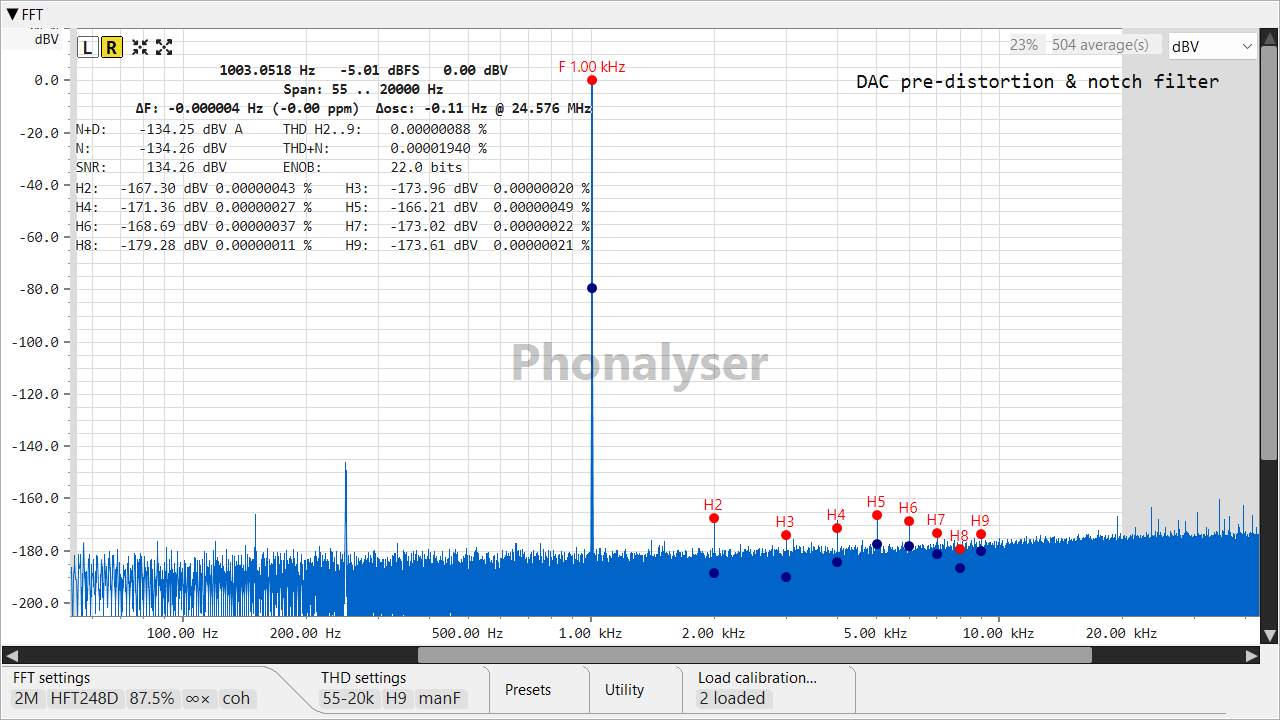
The payoff. A 1003 Hz tone behind the notch, pre-distorted,
at ~730 coherent averages: THD H2...H9 reads 0.00000093 % - under one part
per billion, the individual harmonics down at −160 to −185 dBV.
New here? The DAC
pre-distortion chapter explains why every step above is the way
it is - the notch, the manual fundamental, the deep averaging.